
One of the first questions most people ask before planning their visit is:
“How many days should I stay for Panchakarma?”
This is a practical and important question. But the answer is not always a fixed number.
Unlike wellness packages or short retreats, Panchakarma is a therapeutic process. The duration depends on,
Understanding the logic behind the duration helps set the right expectations and allows the treatment to work more effectively.
Table Of Contents:
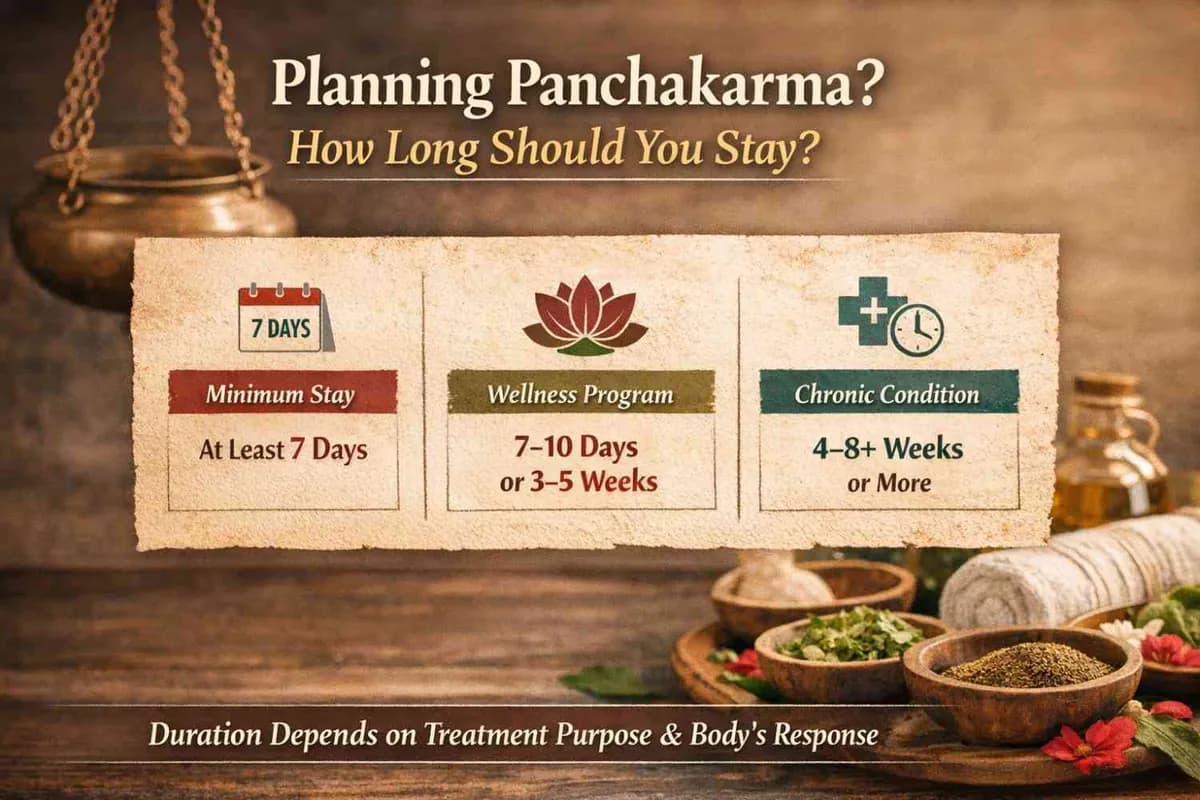
Quick Overview of Panchakarma Duration
The Minimum Duration
At Himveda, the practical minimum stay for Panchakarma is seven days.
This allows enough time for:
Shorter durations usually do not allow meaningful physiological change.
In rare situations, exceptions may be considered. For example, once a patient in active military service had only a few days of leave and strongly wished to consult and begin care. In such special circumstances, we adjusted the plan accordingly. However, such cases are uncommon.
For most people, a stay of less than seven days is unlikely to provide a significant benefit.
Wellness vs Therapeutic Duration
Duration also depends on the purpose of the visit.
For Wellness Panchakarma Duration
Many people initially come for a short wellness program, but those who stay longer often notice more stable improvements in energy, digestion, sleep, and overall balance.
Panchakarma for Chronic Disease Duration
When Panchakarma is planned for a medical condition, the required duration is usually longer.
Most therapeutic programs require:
Chronic diseases develop over time, and meaningful improvement requires adequate time for:
In such cases, Panchakarma weeks in India cannot be determined like a fixed package. Duration is guided by medical assessment and response.
Why Panchakarma Duration Cannot Be Fixed Like a Package
Before arrival, we usually conduct an online consultation and provide an approximate duration based on the patient’s condition.
However, Panchakarma is not a fixed, package-based process.
The body’s response determines:
In some cases, the process moves faster. In others, the body requires more time. For this reason, the duration is best understood as an estimate rather than a fixed commitment.
Healing follows the body’s pace, not a predetermined schedule.
The Importance of Planning the Minimum Stay
One situation that does not work well is when patients plan to come for a few days and then decide later whether to continue.
For example, coming with the intention of “trying Panchakarma for 3–5 days and then deciding” makes it difficult to plan treatment properly.
The treatment approach and pace are decided from the beginning based on the agreed duration. Without a reasonable minimum commitment, it becomes difficult to structure the process effectively.
We therefore request patients to agree on a realistic minimum duration before starting.
Once that minimum period is completed, extension can always be considered.
Extending the Stay: A Common Experience
In fact, extension happens quite often.
Many patients begin to feel the benefits during the course of treatment and realize that staying longer may help them gain deeper and more stable results.
If accommodation and scheduling allow, we are open to extending the stay.
At the same time, treatment planning requires timely clarity. For example, if someone arrives with a plan to stay for one month but is considering extending to six weeks, it is helpful to confirm this within the first week. This allows the treatment sequence to be adjusted appropriately.
Early communication helps us plan the pace and intensity of therapy in the most effective way.
The Real Principle Behind Duration
When people ask about the number of days, the deeper question is usually about expectations.
It is helpful to understand a few basic principles:
Panchakarma is not designed for quick effects. It works by gradually correcting metabolism, reducing internal burden, and allowing the body to restore its balance.
Conclusion
The duration of Panchakarma is not determined by convenience alone. It depends on the purpose of the visit, the condition being addressed, and the body’s response during treatment.
While we provide an initial estimate after consultation, flexibility and openness to the process often lead to better outcomes.
If you are planning Panchakarma, it is best approached with a realistic time commitment and the understanding that deeper healing usually requires patience.
Not sure how long you should stay?
If you are unsure about the duration required for your Panchakarma, you may schedule an online consultation with Dr. Sharma. This allows a detailed assessment of your condition so that the type of Panchakarma and the approximate length of stay can be planned realistically. Book Your Online Consultation Today
Frequently Asked Questions About Panchakarma Duration
1. What is the minimum stay for Panchakarma?
The practical minimum is seven days. Shorter stays usually do not allow meaningful therapeutic work.
2. Is seven days enough for wellness?
Seven to ten days can provide a very basic level of cleansing and metabolic reset. However, deeper wellness benefits are usually seen with stays of three to five weeks.
3. How long should I stay for a chronic condition?
Most therapeutic programs require four to eight weeks. In some cases, longer durations may be recommended depending on the condition and response.
4. Can I extend my stay if I feel I need more time?
Yes. Many patients choose to extend their stay after experiencing the benefits. Extensions are possible based on availability and timely communication.
5. Can I come for a few days and then decide whether to continue?
It is important to agree on a realistic minimum duration before starting. The treatment plan and pace depend on the expected length of stay.
6. If I want to undergo all major Panchakarma procedures, how long will it take?
Some patients request a comprehensive Panchakarma program that includes major procedures such as Vamana (therapeutic vomiting), Virechana (purgation), and Basti (medicated enemas). When multiple major procedures are required, adequate time is needed for proper preparation, recovery, and safe sequencing. In such cases, the treatment may require around 6–8 weeks or more. The exact duration depends on the individual’s condition, strength, and how the body responds, and is finalized after medical evaluation.